Best AI Detector: How to Choose One for Your Writing
If you are looking for the best AI detector, start with one honest rule: no detector should be treated as final proof by itself.
AI detection can help you review a draft, check a suspicious submission, or decide whether writing needs a closer human review. It cannot tell the full story of how a document was created. Scores can change by tool, text length, language, editing style, and even formatting.
A good detector is useful when it answers a practical question: “Should I review this more carefully?” A weak detector turns one score into a verdict.
The Short Answer: Choose by Task, Not One Accuracy Claim
The best AI detector for a blogger is not always the best choice for a teacher, editor, agency, or student. Before choosing a tool, decide what you need it to do.
Use an Best AI detector for:
- Checking long-form articles before publishing
- Reviewing guest posts or outsourced drafts
- Comparing sections that feel too uniform
- Supporting an editorial review process
- Starting a conversation about writing, not ending it
Do not use an AI detector as the only reason to reject, punish, or accuse someone. Turnitin’s own guide says false positives are possible, and it hides AI scores below 20 percent as *% to reduce the risk of overreading low scores. Turnitin also requires at least 300 words of prose for its AI writing report, which shows why short text is a weak testing sample.
Google also does not say that AI content is automatically bad. Its guidance focuses on accuracy, quality, relevance, and helpful content for readers, not on whether a detector gives a low score.
Best AI Detectors Worth Considering
GPTZero
GPTZero is one of the most visible AI detectors and is easy to test because its homepage allows a free scan of pasted text. At the time of checking, the public text box showed a 10,000-character limit before upgrade prompts.
It is a good starting point if you want a quick check, highlighted sections, and a tool that many people already recognize. GPTZero also offers writing process features, such as document replay, which may matter more than a simple percentage when authorship needs context.
Best fit: teachers, writers, editors, and site owners who want a fast first read.
Watch for: vendor accuracy claims. Use the result as a review signal, not a final judgment.
Copyleaks
Copyleaks is useful when your work needs both AI detection and broader content integrity checks. Its AI detector page highlights support for more than 30 languages and offers related tools such as plagiarism checking, browser extensions, Google Docs support, and WordPress integration.
That makes it a practical option for website owners who handle contributor drafts, agency content, or multilingual material.
Best fit: publishers, agencies, and teams that want AI detection near plagiarism and workflow tools.
Watch for: the same issue as every detector. A score still needs human review.
Originality.ai
Originality.ai is built more for publishers, agencies, and site owners than casual one-off checking. Its pricing page lists a free basic option with limited daily credits, while paid plans add more monthly credits and publishing-focused tools.
For a blog like Blogsdays, Originality.ai makes sense if you plan to review many articles, guest posts, or outsourced drafts. It also fits better when you want AI detection beside plagiarism, readability, and editorial checks.
Best fit: website owners, editors, and content teams.
Watch for: cost and workflow. If you only check one short draft now and then, it may be more than you need.
Pangram
Pangram has become worth watching because recent research has compared it with other detectors. A 2025 University of Chicago working paper found Pangram performed strongly in its tested sample, especially on medium and long passages. That does not prove it will be best for every website, language, or future model, but it is a meaningful signal.
Pangram’s pricing page currently lists a 7-day free trial and paid monthly plans. It also includes plagiarism detection on scans, which can be useful if you want one review pass for both AI risk and copied text.
Best fit: users who want a more serious detector and are willing to compare results against other tools.
Watch for: trial limits and paid plan fit before making it part of your regular workflow.
Turnitin, If Your Institution Provides It
Turnitin is different from the other tools because it is usually tied to schools, colleges, and institutions. If you are a student or teacher and your school already uses it, Turnitin’s AI Writing Report may be the system you actually need to understand.
Its report has clear file requirements. The submission must contain at least 300 words of prose, stay under 30,000 words, and use a supported file type such as .docx, .pdf, .txt, or .rtf.
Best fit: academic settings where Turnitin is already enabled.
Watch for: access. Most individual bloggers will not use Turnitin as their main AI detector.
Free Best AI Detector: What Can You Actually Check?
For free checking, start with GPTZero or Copyleaks. Both let you run a quick public scan, and both are easy enough for a beginner.
If you are checking blog content, paste a complete section rather than one sentence. A short paragraph can trigger strange results because the detector has very little writing pattern to judge. Use at least a few hundred words when possible.
For a stronger free review, compare two tools:
- If both say the same section looks suspicious, review that section closely.
- If one tool flags it and another does not, do not panic. Read the text yourself.
- If the text is factual, sourced, specific, and edited in your own voice, a detector score alone should not control the decision.
How to Compare Results Without Mistaking a Score for Proof
The biggest mistake is treating an AI score like a plagiarism match. They are not the same thing.
Plagiarism checking looks for copied or closely matched text. AI detection estimates whether writing patterns resemble machine-generated text. A piece can be original and still get flagged. A copied passage can also pass an AI detector if it was written by a human.
Use this simple review method:
| What You See | What It May Mean | What To Do Next |
|---|---|---|
| Low AI score in one tool | Probably not urgent | Still edit for clarity and facts |
| High AI score in one section | That section may be too generic | Rewrite with specific examples and sources |
| Mixed results across tools | The text is unclear for detection | Review manually before deciding |
| High score on short text | Weak sample | Test a longer passage |
| High AI score plus no sources | Editorial risk | Add sources, examples, and verification |
This is where many people go wrong. They try to “beat” the detector. That is the wrong goal. Your goal is to make the article more useful, more accurate, and easier to trust.
What To Do If Your Own Writing Is Flagged
First, do not delete everything. A false positive can happen, especially with formal, clean, or simple writing.
Check the flagged section and ask:
- Is this too general?
- Does it repeat the same sentence shape?
- Are there claims without sources?
- Could any paragraph belong on any website?
- Did I remove all personal judgment while editing?
Then improve the writing in a normal editorial way. Add the exact tool name, setting, step, problem, example, or source that the reader needs. Replace vague advice with a useful instruction. Cut lines that only sound polished but do not help.
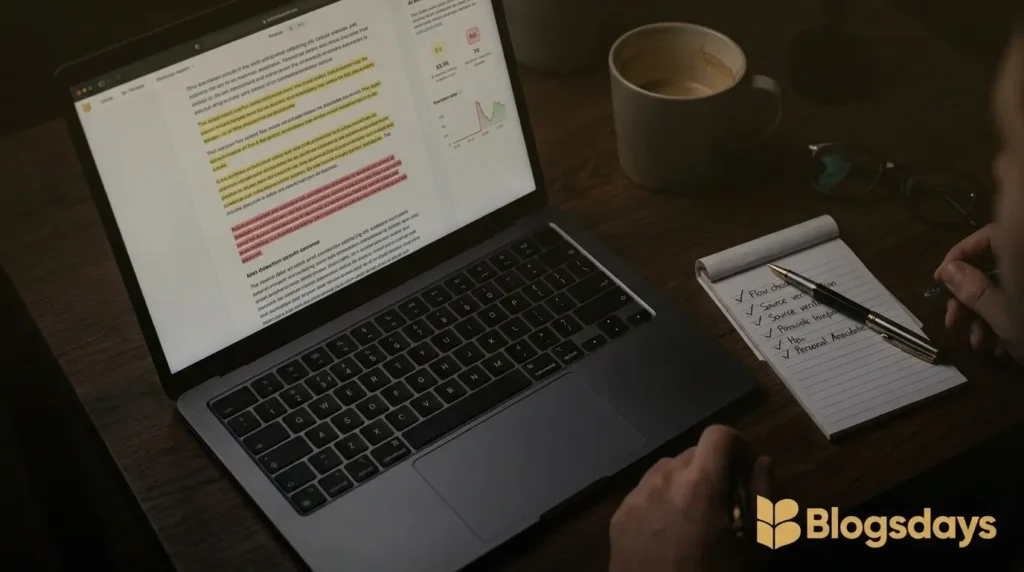
For blog posts, keep a draft history. If you use Google Docs or WordPress revisions, those records can support your process better than a detector score.
AI Detection Is Not Plagiarism Checking
Do not use the best AI detector as a replacement for plagiarism review.
If you publish content, you need both checks in different situations. AI detection can raise questions about writing origin. Plagiarism checking can reveal copied text, missing attribution, or reused paragraphs from another site.
For guest posts and hired writing, use this order:
- Check the draft for plagiarism.
- Review sources and factual claims.
- Use an AI detector as a second signal.
- Edit weak sections for clarity and usefulness.
- Keep records of major edits and approvals.
This protects the site better than chasing a perfect “human” score.
Which Option Fits Your Workflow?
Choose GPTZero if you want a quick scan and easy highlighting.
Choose Copyleaks if you want AI detection near plagiarism, integrations, and multilingual support.
Choose Originality.ai if you run a publishing workflow and need regular checks across many articles.
Choose Pangram if you want to compare a serious paid detector and care about recent benchmark research.
Choose Turnitin only if your school or institution already provides it.
For most bloggers, the best setup is not one magic tool. Use one free detector for quick checks, one plagiarism checker for copied text, and your own editorial process for final decisions.
FAQ
Can Best AI detectors be wrong?
Yes. False positives can happen, and different tools can disagree. Use the score as a signal for review, not as proof.
Is a lower AI score better for Google?
Google’s public guidance does not set an AI detector score requirement. The safer goal is helpful, accurate, original content written for readers.
Should I rewrite content just to pass an Best AI detector?
No. Rewrite only when the text is vague, unsupported, repetitive, or not useful. A better article should help the reader first.
Final Takeaway
The best AI detector is the one that fits your real workflow and keeps you from making rushed decisions. Use it to find sections that deserve attention. Then let sources, editing, and human judgment do the important work.